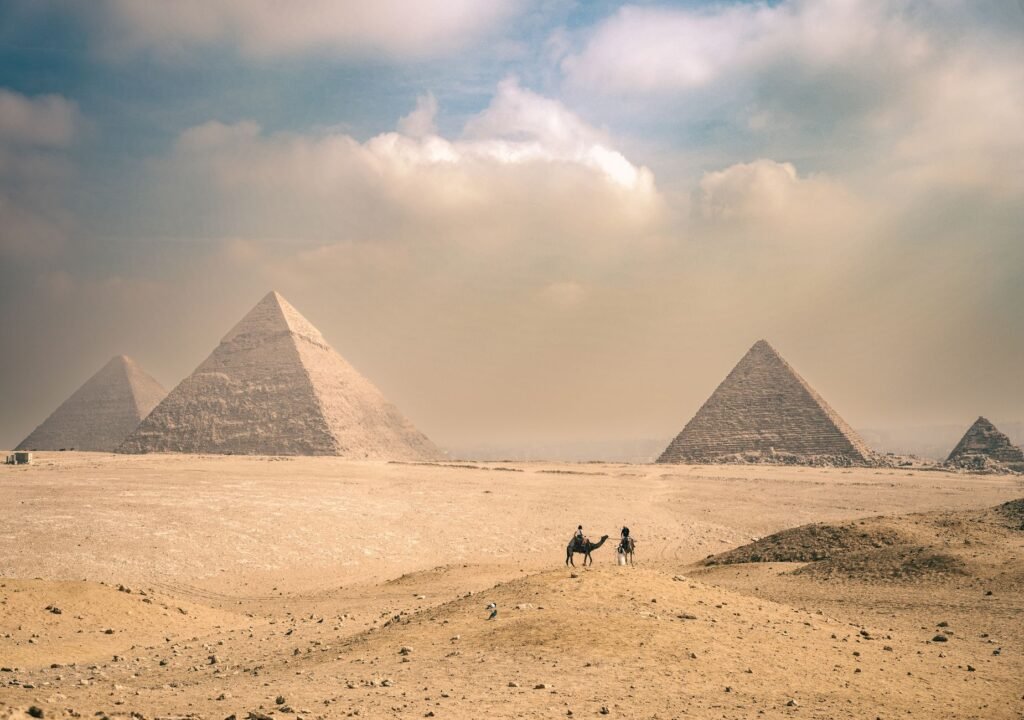
Egypt occupies a complex and recurring role throughout Scripture, serving alternately as a place of refuge, oppression, and deliverance across different periods of biblical history. Its story within the Bible begins generations before the exodus, when Joseph, sold into slavery by his own brothers, rises to become second-in-command over all of Egypt and eventually preserves his family from famine by bringing them to settle there.
What begins as refuge, however, turns into centuries of oppression. By the time of Moses, the Israelites, now numerous, have become enslaved: “The Egyptians worked them ruthlessly. They made their lives bitter with hard labor in brick and mortar and with all kinds of work in the fields” (Exodus 1:13-14). This oppression sets the stage for the defining event of the Old Testament, God’s dramatic deliverance of his people out of Egyptian slavery.
After a series of devastating plagues, Pharaoh finally relents: “During the night Pharaoh summoned Moses and Aaron and said, ‘Up! Leave my people, you and the Israelites! Go, worship the Lord as you have requested'” (Exodus 12:31). This moment of release, the exodus itself, becomes the central act of salvation referenced throughout the rest of the Old Testament, the event by which Israel understood its identity as a people rescued by God.
Egypt’s role in the biblical narrative does not end with the Old Testament. Centuries later, the Gospel of Matthew records that the infant Jesus and his family fled to Egypt to escape King Herod’s massacre of infants in Bethlehem: “So he got up, took the child and his mother during the night and left for Egypt, where he stayed until the death of Herod” (Matthew 2:13-15). Matthew explicitly connects this event to Old Testament prophecy, noting that it fulfilled what was spoken through the prophet Hosea: “Out of Egypt I called my son.”
This pattern, Egypt as both a place of danger and a place of refuge, reflects the complicated way Scripture treats geography generally. No location is inherently good or bad; what matters is God’s activity within it. Egypt is the site of Israel’s bondage and also, for the infant Jesus, a place of safety from a genuinely lethal threat.
The symbolic weight of Egypt within Scripture, primarily as the place of slavery from which God’s people were delivered, made Jesus’ own journey there and back carry deep resonance for early Christian readers familiar with the exodus narrative. Just as Israel was called out of Egypt to become God’s people, Jesus, God’s own Son, is similarly called out of Egypt, reinforcing his identity as the one who embodies and fulfills Israel’s own story.
Egypt, across the whole of Scripture, stands as a recurring reminder that God’s deliverance is not limited by circumstance or geography. Whether rescuing an enslaved nation through the Red Sea or protecting a vulnerable infant family from a murderous king, the biblical pattern is consistent: God works through and beyond the difficult places his people find themselves in.
Abraham’s Earlier Sojourn in Egypt
Egypt’s role in the biblical story reaches back even further than Joseph, to Abraham’s own journey there during a severe famine in Canaan. “So Abram went down to Egypt to live there for a while because the famine was severe” (Genesis 12:10). Fearful that Sarai’s beauty would lead the Egyptians to kill him and take her, Abram presents her as his sister, and Pharaoh indeed takes her into his household, only for God to strike Pharaoh’s house with serious diseases until the truth emerges (Genesis 12:17). Pharaoh, rather than punishing Abram further, sends him away with his wife and considerable wealth intact.
This early episode establishes a pattern that recurs throughout Egypt’s biblical history: it is a place Abraham’s descendants turn to in times of scarcity, and a place where God protects his covenant people even amid their own moral failures and the surrounding political power of Pharaoh’s court. Centuries before Joseph’s family would do the same during a later famine, Abraham had already modeled both the temptation to compromise and God’s faithfulness to preserve his promises despite it.
Joseph’s Rise and the Theology of Providence
Joseph’s ascent in Egypt unfolds through dramatic reversals. Sold into slavery by his brothers, falsely accused in Potiphar’s house, and forgotten in Pharaoh’s prison, Joseph’s fortunes finally turn when he interprets Pharaoh’s troubling dreams of seven fat cows and seven gaunt ones, warning of seven years of abundance followed by seven years of famine. Pharaoh responds by elevating Joseph on the spot: “Since God has made all this known to you, there is no one so discerning and wise as you. You shall be in charge of my palace” (Genesis 41:39-40).
When Joseph’s brothers eventually come to Egypt seeking grain and stand unknowingly before the brother they betrayed, Joseph’s response becomes one of Scripture’s clearest statements of divine providence working through human evil: “You intended to harm me, but God intended it for good to accomplish what is now being done, the saving of many lives” (Genesis 50:20). Egypt, in Joseph’s story, becomes the stage on which God demonstrates that even betrayal and slavery can be woven into a larger plan of preservation and rescue.
The Passover Instituted in Egypt
The final and most severe of the plagues against Egypt, the death of every firstborn son, prompts God to institute a lasting ordinance for Israel even before their deliverance is complete. Each household was instructed to take a lamb, slaughter it, and apply its blood to the doorframes: “The blood will be a sign for you on the houses where you are, and when I see the blood, I will pass over you” (Exodus 12:13). The meal that accompanied this act, eaten in haste with unleavened bread and bitter herbs, was to be observed as “a lasting ordinance” for all generations (Exodus 12:14).
This night in Egypt becomes the founding memory of Israel’s national identity, commemorated annually in the Passover feast for the rest of the Old Testament and directly invoked in the New Testament when Jesus shares his final Passover meal with his disciples before his crucifixion, reframing the bread and cup around his own body and blood (Matthew 26:26-28). Egypt, the place of the original Passover, thus stands behind one of Christianity’s most central observances.
The Crossing of the Red Sea
Israel’s departure from Egypt reaches its dramatic climax not at the border but at the edge of the Red Sea, where Pharaoh’s army, having changed his mind, pursues the fleeing Israelites and traps them against the water. Moses tells the terrified people, “Do not be afraid. Stand firm and you will see the deliverance the Lord will bring you today” (Exodus 14:13). God then drives the sea back with a strong east wind, and “the Israelites went through the sea on dry ground, with a wall of water on their right and on their left” (Exodus 14:22).
When the Egyptian army follows them into the seabed, the waters return and destroy Pharaoh’s forces entirely, prompting Moses and the Israelites to sing a song of victory: “The Lord is my strength and my defense; he has become my salvation” (Exodus 15:2). This event becomes the defining act of deliverance referenced throughout the rest of the Old Testament as the moment Egypt’s power over Israel was decisively and permanently broken.
Egypt in the Prophetic Books
Long after the exodus, Egypt continues to figure prominently in Israel’s prophetic literature, often as a warning against misplaced trust. Isaiah rebukes those who seek security in Egyptian military alliances rather than in God: “Woe to those who go down to Egypt for help, who rely on horses… but do not look to the Holy One of Israel” (Isaiah 31:1). Ezekiel likewise pronounces extended oracles of judgment against Egypt and its Pharaoh, comparing Pharaoh to a great sea monster that God will drag from the waters (Ezekiel 29:3-4).
Yet the prophetic vision of Egypt does not end in judgment alone. Isaiah astonishingly foresees a day when Egypt itself will worship the God of Israel alongside Assyria: “In that day Israel will be the third, along with Egypt and Assyria, a blessing on the earth” (Isaiah 19:24). This remarkable prophetic reversal shows Egypt, the ancient enemy and place of bondage, ultimately drawn into the same redemptive story as Israel itself, a foreshadowing of the gospel’s later reach to all nations.
The Remnant’s Flight to Egypt After Jerusalem’s Fall
Egypt reappears at a low point in Judah’s history following the Babylonian destruction of Jerusalem. Fearing Babylonian reprisal, a remnant of Judah’s survivors resolves to flee to Egypt against the express warning of the prophet Jeremiah, who tells them plainly that God has commanded them to stay in the land (Jeremiah 42:19). They go anyway, taking Jeremiah with them, and settle in Egyptian cities such as Migdol, Tahpanhes, and Memphis (Jeremiah 44:1).
Jeremiah continues to confront them there, condemning their persistence in idolatry even in this foreign refuge (Jeremiah 44:8). This final Old Testament episode involving Egypt closes the circle begun with Abraham and Joseph: the land that once offered genuine deliverance to God’s people now becomes, for a disobedient remnant, a place of exile chosen against God’s own instruction, a sober reminder that Egypt’s role in Scripture depends entirely on whether God’s people seek it in faithful trust or fearful defiance.
Egypt’s Geography and the Land of Goshen
Egypt’s biblical role is shaped by its distinctive geography, a narrow ribbon of fertile land sustained entirely by the annual flooding of the Nile River, surrounded on nearly every side by desert. When Joseph settles his family there, Pharaoh grants them the region of Goshen, in the eastern Nile Delta, described as “the best part of the land” (Genesis 47:11), well suited to shepherding and separate enough from Egyptian population centers to allow Israel to grow into a distinct people over the centuries between Joseph and Moses.
This same geography later shapes the plagues themselves, many of which specifically targeted the Nile and the natural and religious systems Egyptians depended on, from the river turning to blood to the darkness covering the land, while Goshen is repeatedly spared: “the Lord made a distinction between the livestock of Israel and the livestock of Egypt” (Exodus 9:4). Egypt’s fertile isolation, first a refuge and then a place of bondage, was thus also the very geography God used to demonstrate his power on Israel’s behalf, distinguishing his people even while they remained physically within Egypt’s borders.
Solomon’s Alliances and the Warnings Against Trusting Egypt
By the time of the united monarchy, Egypt had shifted from a place of bondage to a political power Israel’s own kings sought to align with, not always to good effect. Solomon secures a marriage alliance with Pharaoh himself, taking “Pharaoh’s daughter and brought her to the City of David” (1 Kings 3:1), and later imports horses and chariots from Egypt as part of his vast trading network (1 Kings 10:28-29). While these alliances reflected Solomon’s international stature, the law of Moses had specifically warned Israel’s future kings against exactly this kind of dependence: “The king must not acquire great numbers of horses for himself or make the people return to Egypt to get more of them” (Deuteronomy 17:16), since the Lord had told Israel they were never to go back that way again.
This tension between political convenience and covenant faithfulness recurs throughout the monarchy, as later kings of Judah repeatedly attempt to secure military protection from Egypt against Assyrian or Babylonian threats, provoking sharp prophetic rebuke. The pattern established in Solomon’s reign, treating the very nation from which Israel had been redeemed as a source of security rather than a reminder of dependence on God alone, becomes a cautionary thread running through the rest of the Old Testament’s account of Israel’s kings.
Egypt as a Recurring Symbol of Worldly Bondage
Beyond its literal historical role, Egypt becomes one of Scripture’s most enduring symbols, shorthand throughout the Bible for slavery, oppression, and the world system opposed to God’s purposes. The prophets repeatedly invoke the exodus from Egypt as the paradigm of salvation itself, and Israel’s psalms and worship regularly recall it as the foundational proof of God’s power and covenant faithfulness, celebrated as the defining act by which God’s people knew him.
Revelation later draws on this same symbolic reservoir, describing the city where two prophetic witnesses are killed in explicitly Egyptian and Sodom-like terms, “the great city that is figuratively called Sodom and Egypt” (Revelation 11:8), showing that even in the New Testament’s final book, Egypt continues to function as a byword for opposition to God long after the historical exodus had passed. Egypt’s biblical legacy, then, is twofold: a real place with a real, complicated history involving God’s people, and an enduring symbol of the bondage from which every subsequent act of divine deliverance in Scripture ultimately draws its meaning.