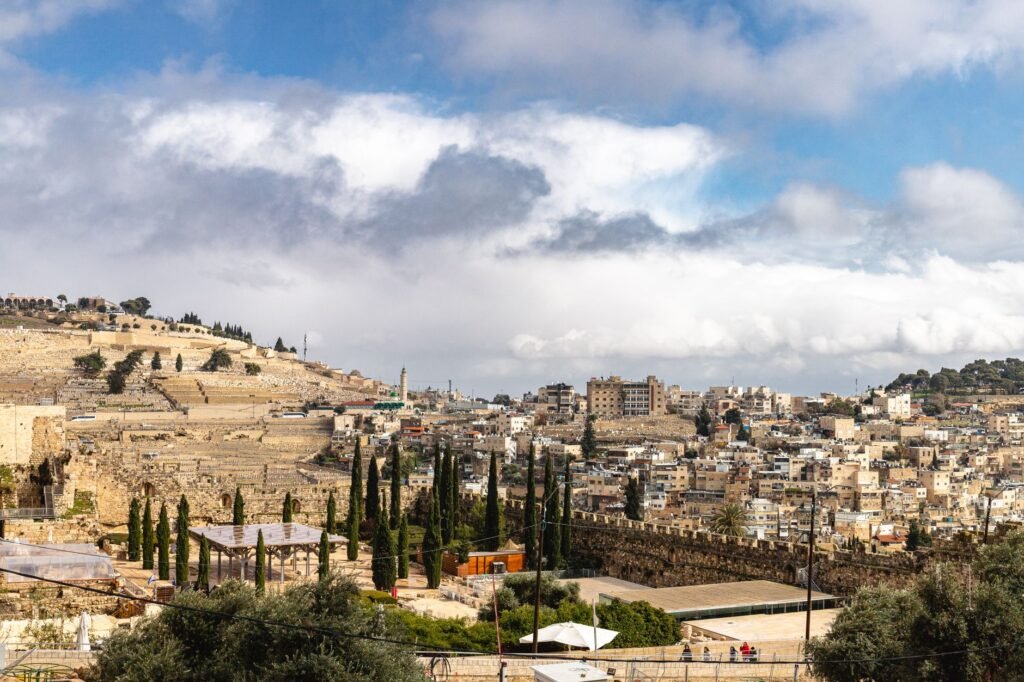
Jerusalem stands as the central city of the entire biblical narrative, the location of Israel’s temple, its kings, and ultimately the crucifixion and resurrection of Jesus Christ. Its significance runs continuously from the Old Testament through the New, and Scripture itself expresses deep affection for the city, as in the psalmist’s call: “Pray for the peace of Jerusalem: ‘May those who love you be secure'” (Psalm 122:6).
Jerusalem’s importance in the Old Testament centers on its role as the site of the temple, the place where God’s presence was understood to dwell among his people in a unique way. Established as Israel’s capital under David and developed further by his son Solomon, who built the first temple there, Jerusalem became the focal point of Israelite worship, the destination of pilgrimage festivals, and the political heart of the nation.
By the New Testament, Jerusalem takes on even greater theological weight as the setting for the climactic events of Jesus’ life. It is in Jerusalem that Jesus is betrayed, tried, crucified, and, three days later, raised from the dead. Luke’s Gospel records the disciples’ response after witnessing the risen and ascending Christ near the city: “Then they worshiped him and returned to Jerusalem with great joy. And they stayed continually at the temple, praising God” (Luke 24:52-53). The city that witnessed Jesus’ darkest hour becomes, in the same Gospel, the site of the disciples’ overwhelming joy at his resurrection and ascension.
Jerusalem also becomes the birthplace of the church itself. It is in Jerusalem that the Holy Spirit descends on the disciples at Pentecost, and the earliest Christian community forms and grows there before the gospel spreads outward to the rest of the world, a geographic pattern Jesus himself had predicted, that the disciples would be his witnesses “in Jerusalem, and in all Judea and Samaria, and to the ends of the earth.”
Scripture’s final vision of Jerusalem looks beyond the earthly city entirely. Revelation describes a new Jerusalem descending from heaven at the close of history: “I saw the Holy City, the new Jerusalem, coming down out of heaven from God, prepared as a bride beautifully dressed for her husband” (Revelation 21:2). This closing image transforms Jerusalem from a specific geographic location into a symbol of God’s ultimate dwelling with his people, the final and complete fulfillment of everything the earthly city had pointed toward throughout the biblical story.
Across the whole of Scripture, Jerusalem functions as far more than a setting; it is a thread that ties together the temple worship of the Old Testament, the crucifixion and resurrection of Christ, the birth of the church, and the ultimate hope of a renewed creation where God dwells fully and finally with his people.
For readers tracing the biblical story from beginning to end, Jerusalem serves as a kind of geographic spine, a city whose earthly history of glory, destruction, and rebuilding mirrors the larger story of God’s redemptive work, culminating in a vision of restoration that reaches beyond the city’s physical walls altogether.
Melchizedek and the Earliest Mention of Salem
Jerusalem’s first appearance in Scripture, under its ancient name Salem, comes centuries before David, in the enigmatic figure of Melchizedek. After Abram rescues his nephew Lot from a coalition of kings, “Melchizedek king of Salem brought out bread and wine. He was priest of God Most High, and he blessed Abram” (Genesis 14:18-19). This brief episode marks Salem, the city later known as Jerusalem, as a place already associated with priesthood and worship of the true God long before Israel existed as a nation.
Melchizedek’s significance grows far beyond this single scene. Psalm 110 later declares of the coming king, “You are a priest forever, in the order of Melchizedek” (Psalm 110:4), a verse the New Testament book of Hebrews applies directly to Christ, presenting Jesus as a priest-king in Melchizedek’s pattern whose priesthood, unlike the Levitical priesthood, has no beginning or end (Hebrews 7:1-3). Jerusalem’s very first mention in the Bible thus already anticipates the priest-king who would one day be crucified within its walls.
Mount Moriah and the Binding of Isaac
Jewish and Christian tradition alike identify the site of Abraham’s most severe test, the binding of Isaac, with the very ground on which Jerusalem’s temple would later stand. God instructs Abraham, “Take your son, your only son, whom you love… and sacrifice him there as a burnt offering on a mountain I will show you” (Genesis 22:2), naming the location as the region of Moriah. When Abraham’s hand is stayed at the last moment and a ram is provided in Isaac’s place, he names the site “The Lord Will Provide” (Genesis 22:14).
Centuries later, when Solomon prepares to build the temple, Scripture specifies its location: “Solomon began to build the temple of the Lord in Jerusalem on Mount Moriah, where the Lord had appeared to his father David” (2 Chronicles 3:1). The connection between Abraham’s willingness to offer his son and the later temple’s sacrificial system, all situated on the same Jerusalem hillside, has led generations of readers to see in this geography an early foreshadowing of God’s own provision of a sacrifice on behalf of his people.
David’s Conquest of the City and the Ark’s Arrival
Before Jerusalem could become Israel’s capital, it had to be taken from the Jebusites, who held it so confidently that they mocked David’s forces, boasting that even the blind and lame could defend its walls (2 Samuel 5:6). David’s men nevertheless captured the fortress by means of the water shaft, and “David then took up residence in the fortress and called it the City of David” (2 Samuel 5:9), transforming a Jebusite stronghold into the political and spiritual center of the nation.
Soon after, David brings the ark of the covenant, Israel’s most sacred object, into the city with unrestrained celebration, dancing before it “with all his might” (2 Samuel 6:14). This moment permanently binds Jerusalem to the presence of God among his people, setting the stage for Solomon’s temple and establishing, centuries before Jesus, the pattern of Jerusalem as the place where heaven and earth were understood to meet.
Destruction, Exile, and Nehemiah’s Rebuilding
Jerusalem’s history includes catastrophic loss as well as glory. In 586 BC, the Babylonian army under Nebuchadnezzar breached the city walls, burned the temple, and carried much of the population into exile: “He set fire to the temple of the Lord, the royal palace and all the houses of Jerusalem” (2 Kings 25:9). The book of Lamentations gives voice to the grief of this destruction: “How deserted lies the city, once so full of people!” (Lamentations 1:1).
Generations later, after the Persian king Cyrus permits the exiles to return, Nehemiah leads the difficult work of rebuilding Jerusalem’s ruined walls despite fierce opposition, completing the task “in fifty-two days” (Nehemiah 6:15), while Ezra leads a parallel restoration of proper worship and the reading of the Law. This cycle of destruction and restoration becomes a recurring pattern in Jerusalem’s story, one that finds its ultimate answer in the New Testament’s vision of a city that can never again be destroyed.
The Triumphal Entry and Jesus’ Lament Over the City
Jesus’ final approach to Jerusalem before his crucifixion is marked by both celebration and sorrow. Crowds welcome him with palm branches, shouting, “Blessed is the king who comes in the name of the Lord!” (Luke 19:38), fulfilling Zechariah’s ancient prophecy of a king entering the city “gentle and riding on a donkey” (Zechariah 9:9; Matthew 21:5). Yet as Jesus draws near and sees the city, his response is not triumph but grief: “As he approached Jerusalem and saw the city, he wept over it” (Luke 19:41), foretelling its coming destruction because it did not recognize “the time of God’s coming” (Luke 19:44).
This lament is fulfilled within a generation when Roman forces destroy Jerusalem and its temple in AD 70, an event Jesus had explicitly predicted: “Not one stone here will be left on another; every one will be thrown down” (Matthew 24:2). The same city that welcomed Jesus with celebration would, within days, call for his crucifixion, and within decades would suffer the very devastation he had wept over in advance.
The Jerusalem Council and the Church’s Global Mission
Jerusalem’s significance extends into the early church’s own defining moments. As the gospel spread to Gentile believers who had not undergone circumcision or kept the Jewish law, sharp disagreement arose over what should be required of them. The apostles and elders gathered in Jerusalem to settle the matter, a meeting now known as the Jerusalem Council, concluding that Gentile believers should not be burdened with the full requirements of Jewish law, “It seemed good to the Holy Spirit and to us not to burden you with anything beyond the following requirements” (Acts 15:28).
This decision, reached in the same city where the church itself had been born at Pentecost, shaped the entire future direction of Christianity as a faith open to all nations rather than confined to one ethnic community. Jerusalem thus functions not only as the site of foundational Old Testament worship and the New Testament’s climactic events, but as the administrative and theological center from which the early church made the decisions that allowed the gospel to spread, just as Jesus had promised, to the ends of the earth.
Solomon’s Temple and Its Place in Jerusalem’s Identity
Solomon’s construction of the first temple represents one of the most significant building projects in the Old Testament, undertaken with cedar from Lebanon, skilled craftsmen, and vast quantities of gold, silver, and bronze. When it was finally dedicated, the glory of the Lord filled the structure so overwhelmingly that “the priests could not perform their service because of the cloud, for the glory of the Lord filled the temple of God” (2 Chronicles 5:14). Solomon’s dedicatory prayer acknowledges the paradox at the heart of Jerusalem’s temple theology, that no building could truly contain the infinite God: “But will God really dwell on earth with humans? The heavens, even the highest heaven, cannot contain you. How much less this temple I have built!” (2 Chronicles 6:18).
This tension, between Jerusalem as the specific place of God’s dwelling and the recognition that God cannot be confined to any single location, runs throughout the rest of Scripture’s treatment of the city, ultimately resolved in the New Testament’s teaching that God’s presence would come to dwell not in a building but among his people themselves, and finally in the descended new Jerusalem where God dwells directly and permanently with humanity.
Jerusalem’s Geography and Its Defensive Significance
Jerusalem’s enduring importance owes something to its geography as well as its theology. Built on a defensible ridge in the Judean hill country, surrounded on several sides by steep valleys, including the Kidron Valley to the east and the Hinnom Valley to the south and west, the city’s natural terrain made it a formidable stronghold long before David’s conquest. Its most reliable water source, the Gihon Spring, lay outside the original city walls in the Kidron Valley, which led to the construction of increasingly sophisticated systems to secure access to it, including the tunnel later associated with King Hezekiah, built to protect the water supply during an Assyrian siege: “It was Hezekiah who blocked the upper outlet of the Gihon spring and channeled the water down to the west side of the City of David” (2 Chronicles 32:30).
This combination of natural defensibility and engineered water security allowed Jerusalem to withstand numerous sieges across its long history, even as it eventually fell to both Babylonian and Roman forces when God’s judgment came upon it. The city’s placement, elevated, encircled by valleys, and centered along a north-south ridge route through Judah’s hill country, made it a natural candidate for a capital, quite apart from its theological significance, though Scripture consistently treats its true security as resting not in its walls or water systems but in the Lord who chose to place his name there.
The Prophets’ Vision of Jerusalem’s Future Glory
Even amid the prophetic warnings of judgment and destruction, Israel’s prophets consistently paired Jerusalem’s condemnation with promises of its future restoration and exaltation. Isaiah envisions a day when “the mountain of the Lord’s temple will be established as the highest of the mountains… and all nations will stream to it” (Isaiah 2:2), with the nations coming to Jerusalem not to conquer it but to learn God’s ways and pursue peace, beating their swords into plowshares. Micah repeats this same vision almost word for word, underscoring how central it was to Israel’s prophetic hope (Micah 4:1-3).
Zechariah, writing after the exile, similarly promises that Jerusalem will one day be renamed “the City of Truth” and that people “of all languages and nations will take firm hold of one Jew by the hem of his robe and say, ‘Let us go with you, because we have heard that God is with you'” (Zechariah 8:23). These prophetic visions, spoken centuries before Jesus, anticipate exactly the pattern fulfilled in the New Testament, where the gospel proclaimed first in Jerusalem draws people from every nation into the people of God, and ultimately point forward to Revelation’s closing picture of the new Jerusalem as the final gathering place of all the redeemed.